
2021, Swoosh, Tsu-pu!, ARKO Art Center, Seoul, Korea
Unfinished: Songs That Do Not Stay, Mijung Kim (Curator, ARKO Art Center)
While writing the wall text for Whale’s Pose (2018) and Lion’s Pose (2016), I chose to use the word “failure.” I admit that I was quite hesitant about it due to its ordinary meaning. The two works mentioned above, The Sea Form of Sound (2021) and the exhibition-related program Bibong Sound Yoga: With Whale in ARKO Art Center (2021), in which the artist earnestly produces the sounds of whales, always brought a question mark to my mind. There is always slippage in efforts to be something else, regardless of how they are done. Even if one transcribes the sound of the whale as “shoosh-pop,” it never matches the actual sound. A yoga posture cannot be identical to a roaring lion. The artist fully understands that her endeavors to be a non-human animal always fail. Therefore, her efforts are meant to create a fusion as an alliance, which is an act of forming a relationship with beings from a different world and crossing the in-between space.8 The artist also firmly believes that without these seemingly unreasonable efforts, it is never possible to understand whales, lions, and the lives of others. The failures become another source of motivation for the artist to come closer to non-human animals.
The artist referring to her art as a “practice” (as if it were a religious practice) may point to the accumulation of repeated failures. However, in line with Haraway’s statement that no one is alone and that nothing will happen unless one is taken into an unanticipated life by another being, the artist deliberately becomes an ally to non-human animals through her excessive imagination and keeps pushing herself into their ever-unknowable lives.
When I placed the word “failure” on the gallery walls, I hoped that someone would understand how expansive the meaning of the word can be. I also wish that the galleries will be filled with questions like “Why is she pushing herself to this extreme?” The artist would be willing to answer the question over and over through her work. However, even after this exhibition closes, one will easily run into Hong Lee, Hyun-Sook, who physically sings the language of non-human beings, talks about being in contact with beings that she cannot get close to (What You Are Touching Now, 2019), and swims in a rice paddy field while dreaming of the sea (Each One’s Own Ieodo, 2020).
Eight, Lightvessels, 2020, sound from eight speakers, dimensions variable, 13min 1sec
The sounds that whales make range from high frequencies to low frequencies. It is a communication tool with their family groups while they travel in the deep sea, and it functions as a mediator for perceiving the outer world. However, the noises from ships and airplanes make the whales’ voices weaker, and in the worst case, they become deaf or get lost. The artist distorts a recording of eight different whales, which human beings cannot hear or elaborate, and plays it in the exhibition space. The recording was done by MBARI. Like whales that explore their worlds through sounds, audiences lie down in an open “room” that resembles a raft, feel the ocean, and float together. The world made up of the whales’ voices comes in contact with the audiences’ bodies and creates a multi-sensory experience.
SOUND EDITING ASSISTANT Jinseung Jang
SOUND MIXING TECHNICIANS AND
PROGRAMMERS Sang-Hyun Kim, Seokbin Oh
CLAY WORK SUPPORT Sujin Kim
The original sound recording of the whales was generously provided by MBARI(www.mbari.org).
SOUND MIXING TECHNICIANS AND
PROGRAMMERS Sang-Hyun Kim, Seokbin Oh
CLAY WORK SUPPORT Sujin Kim
The original sound recording of the whales was generously provided by MBARI(www.mbari.org).
(Text from ARKO Art Center)
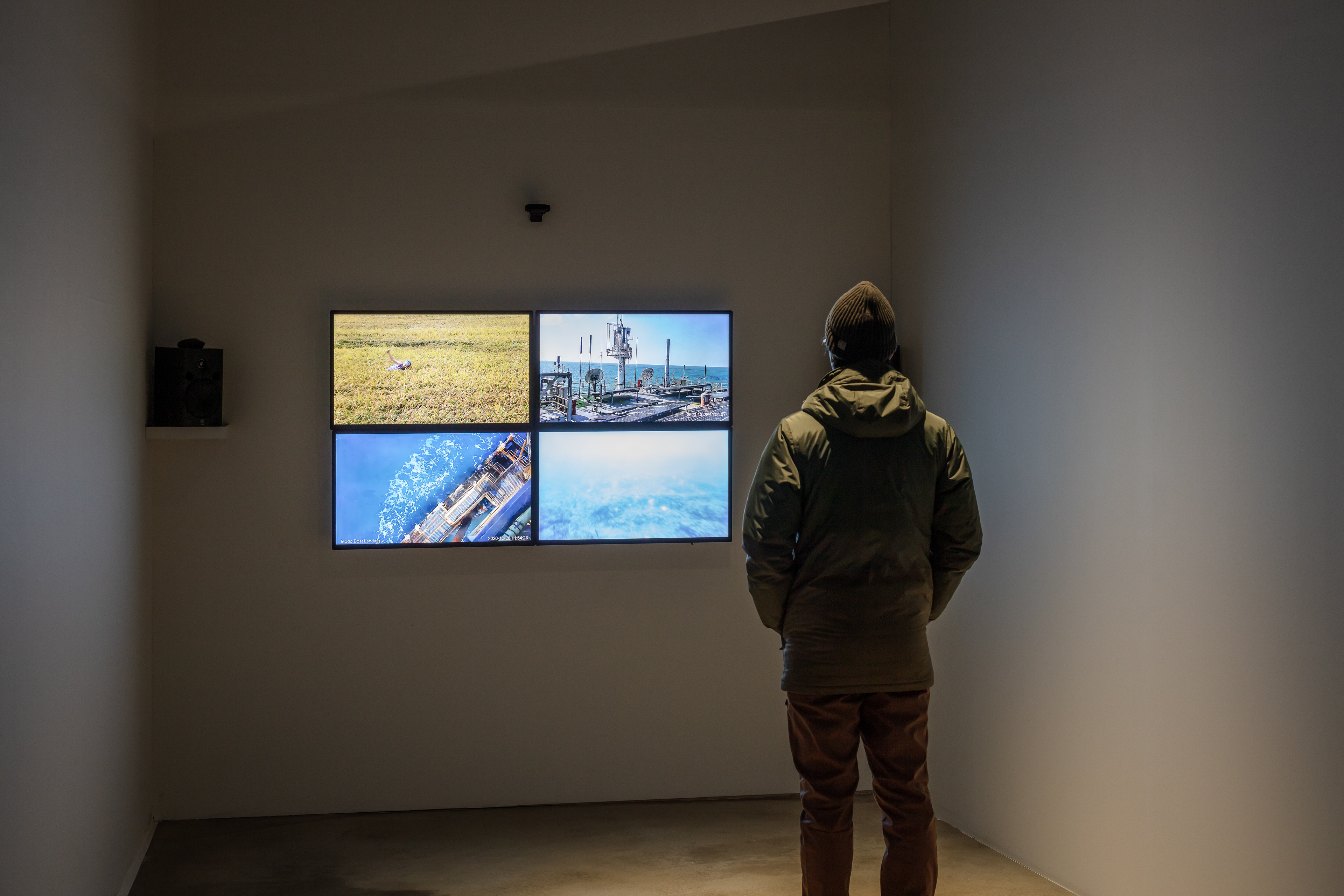

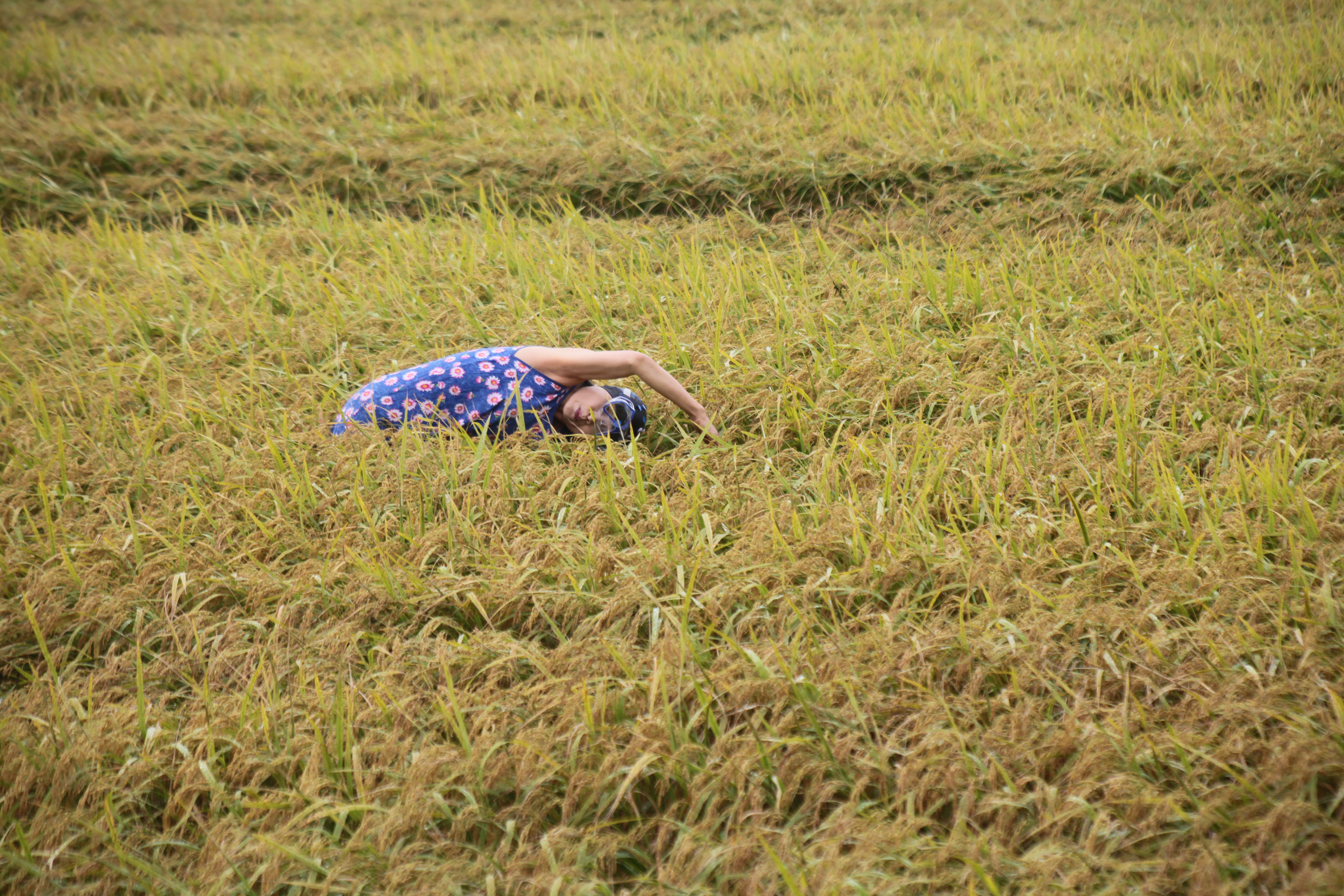


Each Ones’ Own Ieodo, 2020, 4-channel video, color, sound
Channel 1 Swimming in the Rice Paddy, 1min 4sec
Channels 2 and 3 Live streaming from the Ieodo Ocean Research Station’s CCTV cameras
Channel 4 The Sound of Underwater Breathing, 4min 42sec
I've wanted to go to Ieodo since last year. If you go to the middle of the ocean, wouldn't you be able to meet something? However, the boat didn't float well, so we couldn't go to Ieodo (island). Last month, I went to Jejudo (island) because I heard there would be a boat from Jejudo, but I couldn't go because the boat was canceled the day before. The day before yesterday, I had to cancel at the last minute because I had a lot of things to do. The image of Ieodo kept swelling in my head, to the point of exploding. So I started watching CCTV on a small screen in real time on the Internet. That place! I wanted to watch it with someone, and the base staff couldn't resist my phone inquiry and did major work (?) to replace the camera.
As I brought real-time CCTV into my work, I had many questions for myself as an artist. However, numerous birds flying around in real time, a rainy base, a sunset base (2nd channel), and a boat landing (3rd channel) near the end of the exhibition showed a small boat floating past the camera. My act of bringing in the CCTV gave me a strange sense of relief.
As for the rice fields and the sea (1st channel), since the whale work started, there is the sea even when you see the rice fields swaying or when you see a helicopter flying in the sky. It's all sea. When I was flushing water down the toilet, I could see the sea just by hearing the sound of water somewhere, and eventually I saw rice plants bobbing in the rice fields, and it looked like the sea.
The 4th channel actually depicts the experience of going underwater to scuba dive to film the underwater world and coming out soon after without being able to breathe properly. Even though I hadn't properly practiced equalizing (equalizing the external water pressure and the pressure inside our ears), I went into the water with a GoPro camera to take underwater photos. I had to leave after drinking a bowlful of salty seawater in less than 10 minutes, but I will never forget that warmth and softness. The sound of breathing under the sea is a very important keyword in this work. There is no sound in the other three channels, and there is underwater sound only in this fourth channel, which was installed so that the audience can hear the sound only when they stand at a designated location.
Can CCTV really be a work of art? Marcel Duchamp’s (1887-1968) Fountain (1917), which was a urinal comes to mind, but the artist wanted it to be a different work. This Each Ones’ Own Ieodo can be said to be a case where imagination comes first and the scenery follows. In the work Each Ones’ Own Ieodo, CCTV is not a simple neutral transmission medium, but acts as an element that changes at every moment and forms a new relationship.
In this work, The CCTV can be said to have begun with the artist's interest in making a phone call in the hope of seeing Ieodo more clearly as she tried to go to Ieodo, but was unable to, and frequently visited the Ieodo online site to watch the CCTV. In the work, the artist wanted to share with the audience the process and the changing scenery of the sea around Ieodo Island from moment to moment.


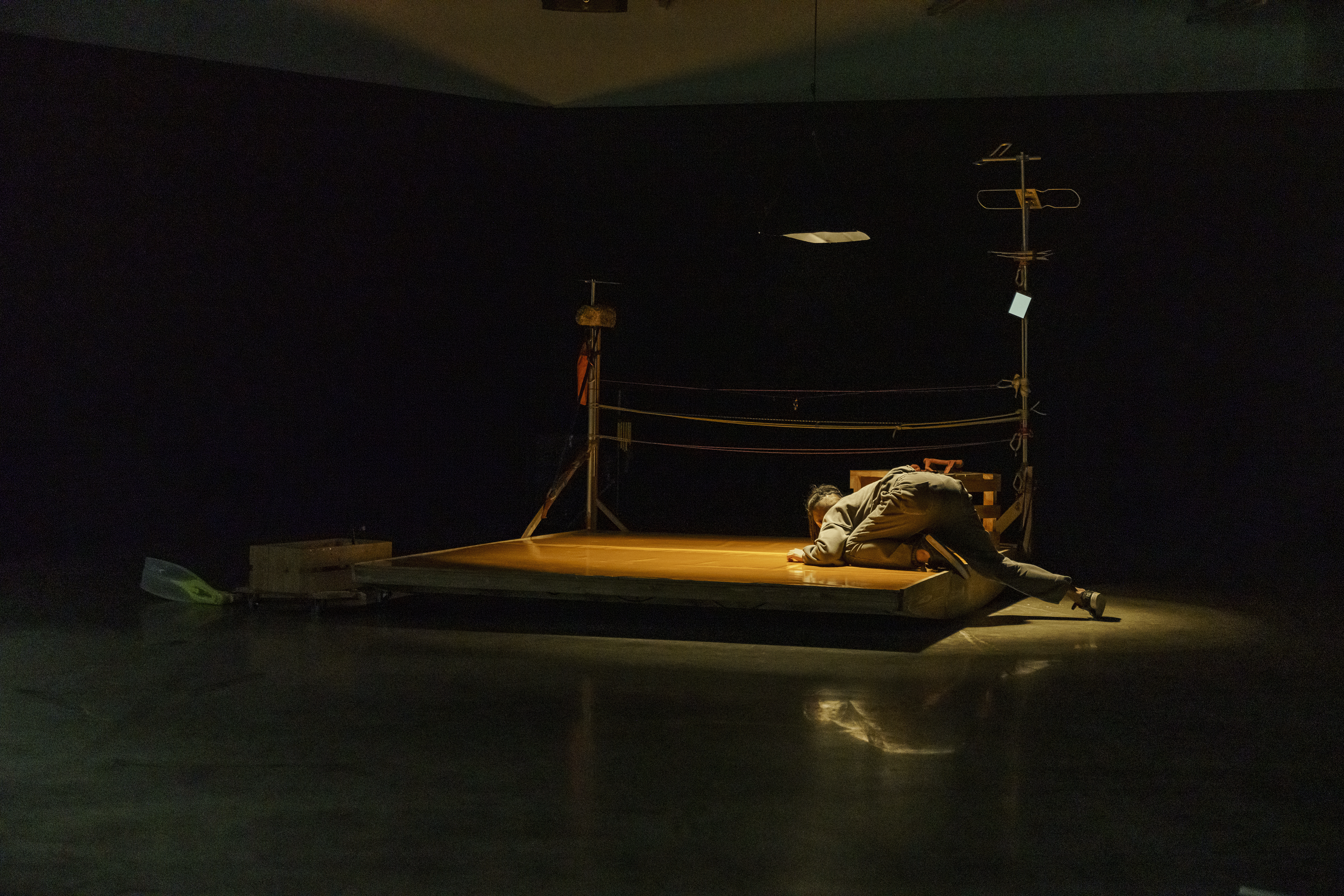

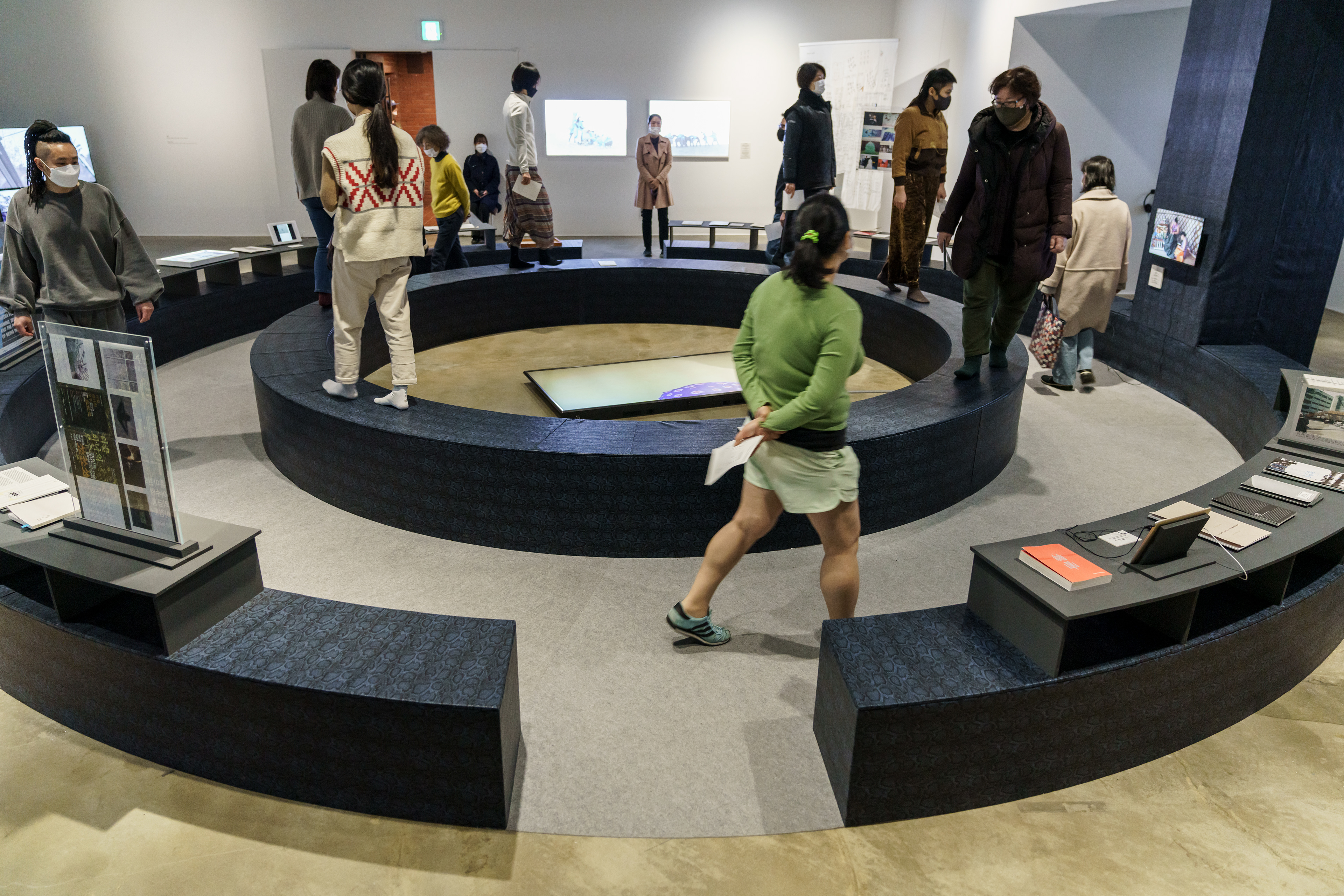
A Voice of Water that Knows How to Get Lost, 2021, performance, about 2hrs
Artist collective Deuk-neungmakmang(Hyun-ah Kang, Junah Kim, Dalo Hyunjoo Kim, Geumhong Lee, Gyeol Yoon, Sooyoung Lee, Sang-Ho Lee)

Dharani for Underwater Animals, 2021, performance, about 20min
Soojin Kim, Sang-Ho Lee, Miyoung Cho and Hong Lee, Hyun-Soo

BIBONG SOUND YOGA: With Whale in ARKO Art Center, 2021, performance, about 30min
Bibong2gil (Yoonji Koo, Hyungil Yoon, Juyeun Jung, Youngju Cho, Yeonha Choi, Yoonhee Heo, Sukyung Hwang and Hong Lee, Hyun-Sook)